

What is the response time of an IPS panel gaming monitor?
Hey there, fellow gamers and tech enthusiasts! I'm stoked to have you here today. As a gaming monitor supplier, I've seen a ton of questions pop up over the years, and one that keeps coming up is, "What is the response time of an IPS panel gaming monitor?" Well, you're in the right place because we're going to dive deep into this topic.
Let's start with the basics. What exactly is response time? In simple terms, response time is how long it takes for a pixel on the monitor to change from one color to another. It's measured in milliseconds (ms). When you're gaming, especially in fast - paced games like first - person shooters or racing games, a low response time is crucial. Why? Because it helps to reduce motion blur and ghosting. Motion blur is that blurry trail you sometimes see behind moving objects in a game, and ghosting is when an image lingers on the screen for a split second after it's supposed to have changed.
Now, when it comes to IPS (In - Plane Switching) panels, they've got a bit of a reputation. Historically, IPS panels were known for having slower response times compared to other panel types like TN (Twisted Nematic) panels. TN panels used to be the go - to for gamers because they could offer really low response times, sometimes as low as 1ms. But IPS panels have come a long way in recent years.
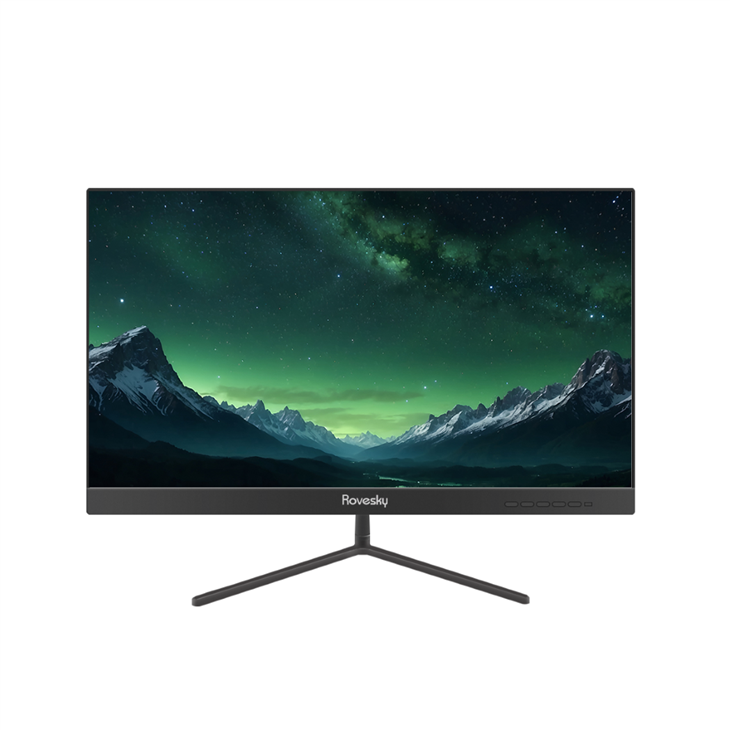
Today, many high - end IPS gaming monitors can achieve response times in the 1 - 4ms range. That's pretty impressive, right? For example, our Rovesky 24 - Inch IPS Gaming Monitor offers a response time of just 2ms. This means that when you're in the heat of a battle, the monitor can quickly change the colors of the pixels, giving you a clear and sharp image without those annoying motion artifacts.

But why would you choose an IPS panel over a TN panel, even with the historical response - time difference? Well, IPS panels have some amazing advantages. First of all, they offer much better color accuracy and wider viewing angles. When you're sitting at your desk gaming, you might not always be looking at the monitor straight on. With an IPS panel, you can view the screen from almost any angle without the colors washing out or the image looking distorted. This is great if you're sharing your gaming setup with friends or if you like to lean back and relax while you play.
Color accuracy is also a big deal, especially for games that have rich and detailed visuals. IPS panels can display a wider range of colors and more accurate shades, making the game world look more vibrant and realistic. Whether you're exploring a lush fantasy landscape or racing through a neon - lit city, the colors on an IPS panel will really pop.
Let's talk a bit more about how response time affects different types of games. In fast - paced action games, as I mentioned earlier, a low response time is essential. Games like "Counter - Strike: Global Offensive" or "Call of Duty" require quick reactions, and a monitor with a slow response time can give your opponents an edge. You might not be able to see an enemy clearly because of motion blur, or you could miss a crucial moment because of ghosting.
On the other hand, in slower - paced games like strategy games or role - playing games, response time might not be as critical. These games are more about planning and decision - making, and the action isn't as fast - moving. However, even in these types of games, a low response time can still enhance the overall experience. You'll notice smoother animations and a more fluid gameplay feel.
Now, if you're a fan of high - refresh - rate gaming, response time becomes even more important. Refresh rate is how many times per second the monitor updates the image on the screen, and it's measured in Hertz (Hz). A high - refresh - rate monitor, like our Rovesky 32 - Inch Curved Gaming Monitor – 240Hz, can make the game look incredibly smooth. But if the response time is too high, you won't be able to fully take advantage of that high refresh rate. The monitor won't be able to change the pixel colors fast enough to keep up with the rapid image updates, and you'll still end up with motion blur.
So, how do manufacturers achieve low response times on IPS panels? It's a combination of advanced panel technology and special algorithms. Manufacturers are constantly researching and developing new ways to make the liquid crystals in the panel switch faster. They also use overdrive technology, which applies an extra voltage to the pixels to speed up the color - changing process. However, overdrive can sometimes cause its own problems, like overshoot. Overshoot is when the pixel changes too far past the desired color and then has to correct itself, which can lead to a brief color artifact. But modern monitors are getting better at managing overdrive to minimize these issues.
Another factor to consider is the cost. Generally, monitors with lower response times tend to be more expensive. This is because it takes more advanced technology and better - quality components to achieve those fast pixel - switching speeds. But as technology improves, the price gap between monitors with different response times is starting to narrow. Our Rovesky 21.45 - Inch Full HD LCD Monitor offers a great balance between performance and affordability, with a response time of 1.2ms at a very reasonable price.
If you're in the market for a new gaming monitor, I highly recommend considering an IPS panel with a low response time. It might cost a bit more upfront, but the improvement in your gaming experience will be well worth it. Whether you're a casual gamer or a professional esports player, a good monitor can make a huge difference in how you enjoy your games.
If you're interested in learning more about our gaming monitors or are thinking about making a purchase, we'd love to hear from you. We're always here to answer any questions you might have and help you find the perfect monitor for your needs. Just reach out to us, and we can start a conversation about your gaming setup and what would work best for you.
In conclusion, the response time of an IPS panel gaming monitor has come a long way, and it's now competitive with other panel types while still offering the amazing color and viewing - angle benefits that IPS is known for. So, don't let the historical reputation of IPS panels hold you back. Take a look at our range of monitors, and I'm sure you'll find one that will take your gaming to the next level.
References:
- Various gaming - monitor industry reports and reviews
- Technical specifications provided by monitor manufacturers