

What is the difference between OLED and LCD smart mobile display screens?
Hey there! As a supplier of smart mobile display screens, I often get asked about the differences between OLED and LCD screens. So, I thought I'd take a moment to break it down for you in a way that's easy to understand.
First off, let's talk about the basics. LCD, or Liquid Crystal Display, has been around for quite a while. It's the technology you'll find in a lot of older smartphones, tablets, and even some TVs. LCD screens work by using a backlight to shine through liquid crystals. These crystals can be manipulated to block or allow light to pass through, creating the images you see on the screen.
On the other hand, OLED, or Organic Light - Emitting Diode, is a newer technology. In an OLED screen, each pixel emits its own light. That means there's no need for a backlight like in an LCD. This fundamental difference leads to several key distinctions between the two types of screens.
Picture Quality
One of the most noticeable differences is in picture quality. OLED screens have a huge advantage when it comes to contrast ratios. Since each pixel in an OLED can be completely turned off, it can achieve true blacks. This results in a much more immersive viewing experience, especially when watching movies or playing games with dark scenes. For example, in a horror movie with a lot of dark corridors, an OLED screen will make those shadows look truly black, adding to the suspense.
In contrast, LCD screens struggle to achieve true blacks. Even when the liquid crystals are supposed to block all the light from the backlight, some light still leaks through. This can make dark scenes look a bit washed out or grayish.
Color accuracy is another area where OLED shines. OLED pixels can produce a wider range of colors with more vividness and accuracy. The colors on an OLED screen look more like what you'd see in real life. LCD screens, while they've improved over the years, still can't quite match the color performance of OLED. If you're into photography or graphic design and need to view your work accurately on a screen, an OLED screen would be a better choice.
Viewing Angles
Viewing angles are also an important factor, especially if you're sharing your screen with others. OLED screens have excellent viewing angles. You can view an OLED screen from almost any angle without noticing a significant drop in picture quality. The colors remain vibrant, and the contrast stays high. This is great for group viewing, like when you're watching a sports game with friends.
LCD screens, however, have more limited viewing angles. As you move away from the center of the screen, the colors can start to look washed out, and the contrast can decrease. So, if everyone in the room wants to have a good view of the screen, an OLED might be the way to go.
Power Consumption
Power consumption is a big deal, especially for mobile devices. OLED screens are generally more energy - efficient than LCD screens, especially when displaying a lot of dark content. Since the pixels in an OLED can be turned off completely, they don't use any power when they're black. This is a huge advantage for smartphones, as it can help extend battery life.
LCD screens, on the other hand, need to keep the backlight on all the time, even when displaying dark images. This means they use more power overall, especially if you're using the device in a dark environment where the backlight has to be dimmed.
Durability
When it comes to durability, LCD screens have an edge. OLED screens are more prone to a phenomenon called burn - in. Burn - in occurs when a static image is displayed on the screen for a long time, causing the pixels to degrade at different rates. This can result in a faint ghost image remaining on the screen even when a different image is being displayed. This is a concern for users who often leave their screens on the same app or interface for extended periods, like gamers who play the same game for hours or people who use their phones as a dashboard for a long time.
LCD screens don't have this issue of burn - in. They are generally more resistant to long - term static image display. However, LCD screens are more vulnerable to physical damage. The backlight and the liquid crystal layer can be easily damaged if the screen is dropped or subjected to pressure.
Cost
Cost is always a consideration when choosing a display screen. OLED screens are typically more expensive than LCD screens. The manufacturing process for OLED is more complex and costly, which is reflected in the price of devices with OLED screens. If you're on a budget, an LCD screen might be a more affordable option. But if you're willing to spend a bit more for the best picture quality and other benefits, then an OLED screen is worth the investment.
Our Product Range
At our company, we offer a variety of smart mobile display screens, including both OLED and LCD options. For those who are looking for a high - end viewing experience, we have some great OLED models. And if you're looking for a more budget - friendly option, our LCD screens are a great choice.
We have some really cool products like the Rovesky 21 - Inch 4K Portable Touch Monitor Pro. This monitor is perfect for those who need a portable and high - resolution display. It can be used for work, entertainment, or even as a secondary screen for your laptop.
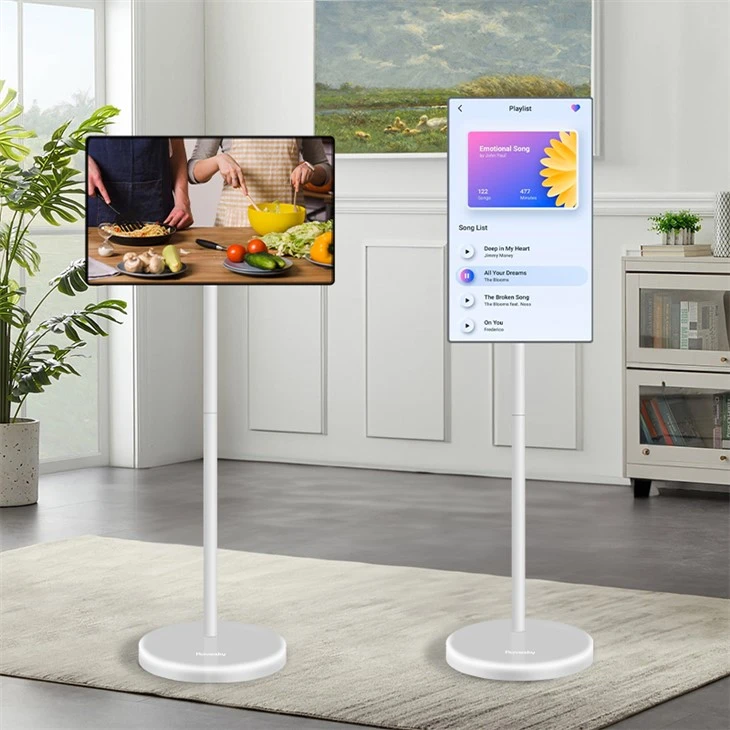
Another great product is the Rovesky 23.8 - Inch Stand By Me Smart Portable TV. It's a versatile device that can be easily moved around the house. You can take it from your living room to your bedroom and enjoy your favorite shows wherever you are.
And for those who want a larger screen, we have the Rovesky 27 - Inch Stand By Me Smart Portable TV. This TV offers a big and immersive viewing experience, whether you're watching movies or playing games.

Which One Should You Choose?
So, which type of screen is right for you? It really depends on your needs and preferences. If you're a media enthusiast who wants the best possible picture quality, especially for watching movies and playing games, and you're willing to pay a bit more, then an OLED screen is the way to go. But if you're on a tight budget, or you're worried about burn - in and need a more durable screen for long - term static image display, an LCD screen might be a better fit.
If you're interested in learning more about our smart mobile display screens or have any questions about OLED and LCD, don't hesitate to reach out. We're here to help you make the right choice for your needs. Whether you're a retailer looking to stock our products or an individual consumer, we're happy to discuss your requirements and provide you with the best solutions. Contact us to start a purchase negotiation and get the perfect display screen for you.
References
- "Display Technology: LCD vs. OLED." TechRadar.
- "The Difference Between LCD and OLED Screens." CNET.
- "OLED vs. LCD: Which Display Technology is Right for You?" PCMag.