

How accurate are the touch controls on a smart board for the office?
Hey there! As a supplier of smart boards for the office, I've been getting a lot of questions lately about how accurate the touch controls on these devices really are. It's a crucial aspect, especially when you're using a smart board for presentations, brainstorming sessions, or collaborative work. So, let's dive right in and explore this topic.
First off, what makes touch control accuracy so important in an office smart board? Well, think about it. In a business setting, time is money. If you're trying to draw a diagram, annotate a document, or navigate through a presentation, and the touch controls aren't accurate, it can lead to frustration and wasted time. You don't want to be struggling to get the pen to draw where you want it or having to constantly correct the cursor's position.
The technology behind touch controls on smart boards has come a long way in recent years. Most modern office smart boards use either infrared (IR) or projected capacitive (PCAP) touch technology. Each has its own pros and cons when it comes to accuracy.
Infrared touch technology works by having an array of infrared sensors around the edge of the smart board. When you touch the screen, it interrupts the infrared beams, and the system calculates the position of the touch based on which beams are broken. One of the great things about IR touch is that it can detect multiple touches at the same time, which is perfect for collaborative work. However, it can sometimes be a bit less accurate when it comes to fine details. For example, if you're trying to draw a really thin line or make a precise annotation, you might find that the line isn't as sharp as you'd like.
On the other hand, projected capacitive touch technology is similar to what you find on your smartphone or tablet. It uses a conductive layer on the screen to detect changes in electrical current when you touch it. PCAP touch is known for its high accuracy and responsiveness. It can detect even the lightest touch and is great for tasks that require precision, like digital painting or detailed diagramming. But, it can be a bit more expensive than IR touch, which might be a factor for some businesses on a budget.
So, how do you know if the touch controls on a particular smart board are accurate? Well, there are a few things you can look for. First, check the resolution of the touch sensor. A higher resolution generally means more accurate touch detection. You should also look for reviews from other users. Real-world experiences can give you a good idea of how well the touch controls work in a practical setting.
Let's take a look at one of our popular products, the Rovesky 55-Inch 4K Smart Digital Whiteboard. This smart board uses advanced PCAP touch technology, which means you can expect incredibly accurate touch controls. Whether you're using a finger or a stylus, the board responds quickly and precisely. You can draw smooth lines, make detailed annotations, and navigate through presentations with ease.

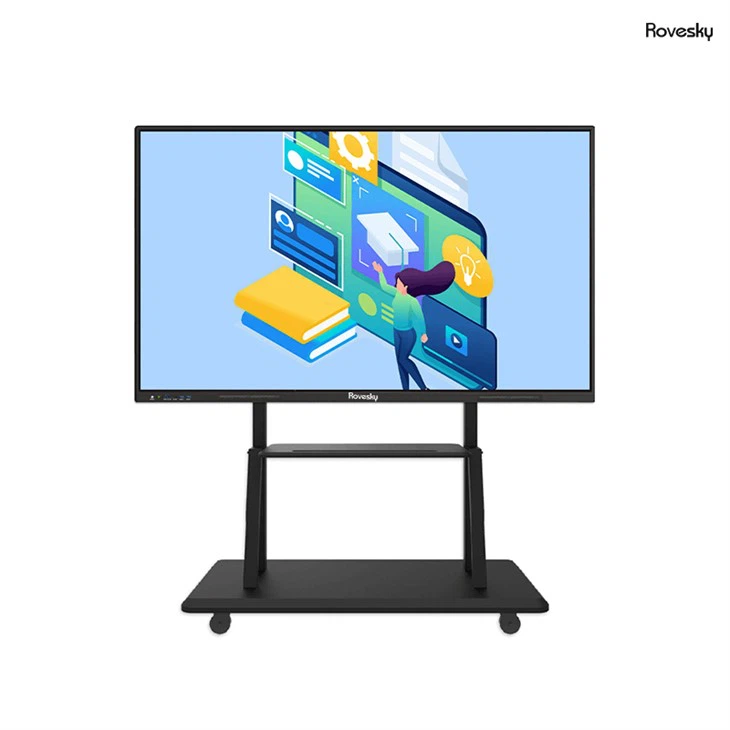
In addition to the touch technology itself, the software that runs on the smart board also plays a big role in touch control accuracy. Our smart boards come with intuitive software that has been optimized for touch input. It allows you to customize the sensitivity of the touch controls, so you can find the perfect setting for your needs. You can also use gestures to perform common tasks, like zooming in and out or scrolling through pages.
Another factor that can affect touch control accuracy is the surface of the smart board. A smooth, scratch-resistant surface is essential for accurate touch detection. Our smart boards are designed with high-quality glass surfaces that not only provide a great writing experience but also ensure that the touch controls work flawlessly.
Of course, like any technology, there can be some occasional issues with touch control accuracy. For example, if the smart board is exposed to extreme temperatures or humidity, it might affect the performance of the touch sensors. That's why it's important to follow the manufacturer's recommendations for installation and maintenance.
In conclusion, the accuracy of touch controls on a smart board for the office is a critical factor to consider. With the right technology, software, and surface, you can get a smart board that offers precise and responsive touch controls. If you're in the market for an office smart board, I encourage you to take a closer look at our products. We're confident that you'll be impressed with the touch control accuracy and overall performance.
If you're interested in learning more about our smart boards or have any questions about touch control accuracy, don't hesitate to get in touch. We're here to help you find the perfect solution for your office needs. Whether you're a small business or a large corporation, we have a smart board that will meet your requirements.
References
- Various industry reports on smart board technology
- User reviews of office smart boards