

Can a smart board for the classroom display 3D content?
In today's rapidly evolving educational landscape, technology has become an indispensable tool for enhancing the learning experience. One such technological advancement that has gained significant popularity in classrooms is the smart board. These interactive whiteboards offer a range of features and capabilities that can transform traditional teaching methods into engaging and immersive learning experiences. One question that often arises is whether a smart board for the classroom can display 3D content. In this blog post, we will explore this topic in detail and discuss the potential benefits and challenges of using 3D content on smart boards in educational settings.
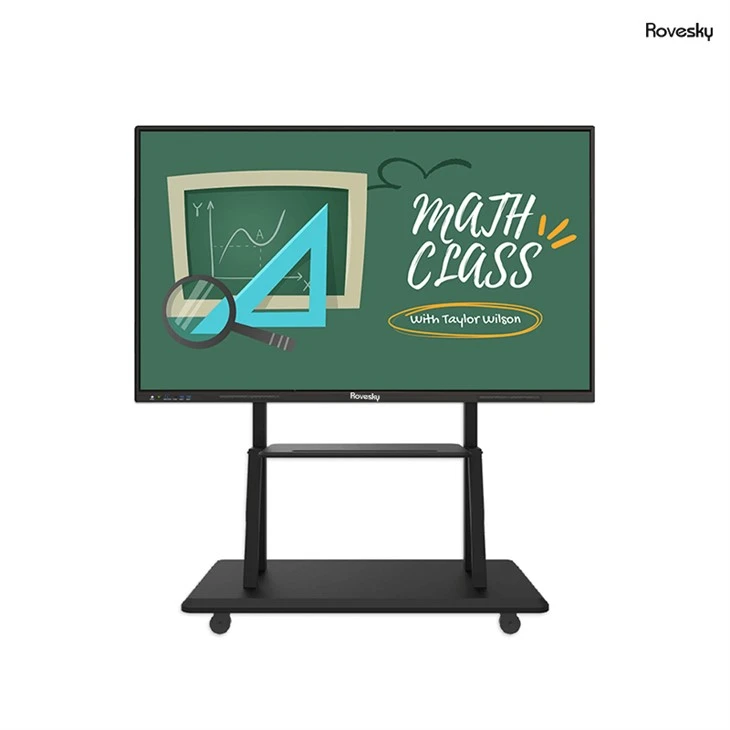
As a leading supplier of smart boards for classrooms, we understand the importance of providing educators with the latest technology to support their teaching objectives. Our Rovesky 65'' 4K Touchscreen Whiteboard is designed to meet the diverse needs of modern classrooms, offering high-resolution displays, interactive touch capabilities, and a range of connectivity options. But can it display 3D content? The answer is yes, and here's how.

How Smart Boards Can Display 3D Content
Smart boards are essentially large, interactive displays that can connect to a variety of devices, including computers, laptops, tablets, and smartphones. To display 3D content on a smart board, you will need a source of 3D content, such as a 3D video, a 3D model, or a 3D game. You will also need a device that can output 3D content, such as a 3D-enabled computer or a 3D Blu-ray player. Once you have these components, you can connect your device to the smart board using an appropriate cable, such as an HDMI cable or a VGA cable.
Once the device is connected to the smart board, you can use the smart board's touchscreen interface to interact with the 3D content. For example, you can use your fingers to rotate, zoom, and pan the 3D model, or you can use the smart board's stylus to draw on the 3D surface. Some smart boards also support multi-touch gestures, which allow multiple users to interact with the 3D content simultaneously.
Benefits of Using 3D Content on Smart Boards in the Classroom
There are several benefits to using 3D content on smart boards in the classroom. First and foremost, 3D content can enhance the learning experience by providing students with a more immersive and engaging way to interact with the material. For example, in a science class, students can use 3D models to explore the structure of molecules or the anatomy of the human body. In a history class, students can use 3D reconstructions to explore ancient civilizations or historical events. By allowing students to interact with the material in a more hands-on way, 3D content can help to improve their understanding and retention of the information.
Another benefit of using 3D content on smart boards is that it can help to cater to different learning styles. Some students are visual learners, while others are kinesthetic learners. By providing 3D content that can be interacted with using touch gestures, smart boards can accommodate both types of learners. Visual learners can benefit from the detailed and realistic visual representation of the 3D content, while kinesthetic learners can benefit from the hands-on interaction with the material.
In addition, using 3D content on smart boards can help to make the classroom more inclusive. For example, students with disabilities, such as visual impairments or learning disabilities, may find it easier to understand and interact with 3D content than traditional 2D content. By providing 3D content on smart boards, educators can ensure that all students have equal access to the learning material.
Challenges of Using 3D Content on Smart Boards in the Classroom
While there are many benefits to using 3D content on smart boards in the classroom, there are also some challenges that need to be addressed. One of the main challenges is the availability of 3D content. While there is a growing amount of 3D content available online, much of it is not specifically designed for educational purposes. Educators may need to spend time searching for and curating appropriate 3D content for their lessons.
Another challenge is the technical requirements for displaying 3D content. As mentioned earlier, you will need a source of 3D content and a device that can output 3D content. These components can be expensive, and not all schools may have the budget to invest in them. In addition, some older smart boards may not be compatible with 3D content, which means that schools may need to upgrade their equipment.
Finally, there is the issue of student distraction. While 3D content can be engaging and immersive, it can also be distracting if not used appropriately. Educators need to ensure that the 3D content is relevant to the lesson and that students are using it in a focused and productive way.
Conclusion
In conclusion, a smart board for the classroom can display 3D content, and there are many benefits to using 3D content in educational settings. By providing students with a more immersive and engaging way to interact with the material, 3D content can enhance the learning experience and improve student understanding and retention. However, there are also some challenges that need to be addressed, such as the availability of 3D content, the technical requirements for displaying 3D content, and the issue of student distraction.
As a supplier of smart boards for classrooms, we are committed to providing educators with the latest technology and support to help them overcome these challenges. Our Rovesky 65'' 4K Touchscreen Whiteboard is designed to support 3D content and offers a range of features and capabilities that can enhance the learning experience. If you are interested in learning more about our smart boards or would like to discuss your specific needs, please contact us to schedule a consultation. We look forward to working with you to transform your classroom into a dynamic and engaging learning environment.
References
- Johnson, L., Adams Becker, S., Estrada, V., & Freeman, A. (2015). NMC Horizon Report: 2015 Higher Education Edition. New Media Consortium.
- Mayer, R. E. (2009). Multimedia Learning (2nd ed.). Cambridge University Press.
- National Research Council. (2012). Education for Life and Work: Developing Transferable Knowledge and Skills in the 21st Century. The National Academies Press.